Antiplane shear or antiplane strain is a special state of strain in a body. This state of strain is achieved when the displacements in the body are zero in the plane of interest but nonzero in the direction perpendicular to the plane. For small strains, the strain tensor under antiplane shear can be written as

ε = [ 0 0 ϵ 13 0 0 ϵ 23 ϵ 13 ϵ 23 0 ] {\displaystyle {\boldsymbol {\varepsilon }}={\begin{bmatrix}0&0&\epsilon _{13}\\0&0&\epsilon _{23}\\\epsilon _{13}&\epsilon _{23}&0\end{bmatrix}}}

where the 12 {\displaystyle 12\,} plane is the plane of interest and the 3 {\displaystyle 3\,} direction is perpendicular to that plane.

Displacements

The displacement field that leads to a state of antiplane shear is (in rectangular Cartesian coordinates)

u 1 = u 2 = 0   ;     u 3 = u ^ 3 ( x 1 , x 2 ) {\displaystyle u_{1}=u_{2}=0~;~~u_{3}={\hat {u}}_{3}(x_{1},x_{2})}

where u i ,   i = 1 , 2 , 3 {\displaystyle u_{i},~i=1,2,3} are the displacements in the x 1 , x 2 , x 3 {\displaystyle x_{1},x_{2},x_{3}\,} directions.

Stresses

For an isotropic, linear elastic material, the stress tensor that results from a state of antiplane shear can be expressed as

σ [ σ 11 σ 12 σ 13 σ 12 σ 22 σ 23 σ 13 σ 23 σ 33 ] = [ 0 0 μ   u 3 x 1 0 0 μ   u 3 x 2 μ   u 3 x 1 μ   u 3 x 2 0 ] {\displaystyle {\boldsymbol {\sigma }}\equiv {\begin{bmatrix}\sigma _{11}&\sigma _{12}&\sigma _{13}\\\sigma _{12}&\sigma _{22}&\sigma _{23}\\\sigma _{13}&\sigma _{23}&\sigma _{33}\end{bmatrix}}={\begin{bmatrix}0&0&\mu ~{\cfrac {\partial u_{3}}{\partial x_{1}}}\\0&0&\mu ~{\cfrac {\partial u_{3}}{\partial x_{2}}}\\\mu ~{\cfrac {\partial u_{3}}{\partial x_{1}}}&\mu ~{\cfrac {\partial u_{3}}{\partial x_{2}}}&0\end{bmatrix}}}

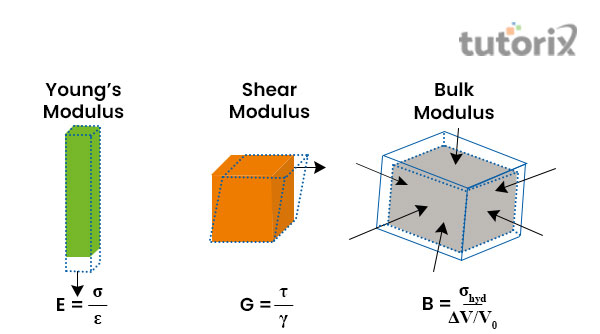
where μ {\displaystyle \mu \,} is the shear modulus of the material.

Equilibrium equation for antiplane shear

The conservation of linear momentum in the absence of inertial forces takes the form of the equilibrium equation. For general states of stress there are three equilibrium equations. However, for antiplane shear, with the assumption that body forces in the 1 and 2 directions are 0, these reduce to one equilibrium equation which is expressed as

μ   2 u 3 b 3 ( x 1 , x 2 ) = 0 {\displaystyle \mu ~\nabla ^{2}u_{3} b_{3}(x_{1},x_{2})=0}

where b 3 {\displaystyle b_{3}} is the body force in the x 3 {\displaystyle x_{3}} direction and 2 u 3 = 2 u 3 x 1 2 2 u 3 x 2 2 {\displaystyle \nabla ^{2}u_{3}={\cfrac {\partial ^{2}u_{3}}{\partial x_{1}^{2}}} {\cfrac {\partial ^{2}u_{3}}{\partial x_{2}^{2}}}} . Note that this equation is valid only for infinitesimal strains.

Applications

The antiplane shear assumption is used to determine the stresses and displacements due to a screw dislocation.

References

See also

  • Infinitesimal strain theory
  • Deformation (mechanics)

Possible failure (shear) planes (reproduced from Costa et al. [14

2 Snapshot of six different configurations (a) simple shear plane

7 Antiplane shear mode Download Scientific Diagram

Schematic representation of the antiplane problem shear problem for

Shear Modulus Elastic Moduli